Family Spokesperson Briefing Sheet for Wedding Discussions
A useful family spokesperson wedding briefing fits on one page and answers five questions: who speaks, what has been agreed, which items or messages are involved, when each step happens, and what still needs confirmation. Prepare it with the couple and the designated spokesperson before the discussion, then share the final version with relatives whose arrival, contribution, or decision affects the plan.
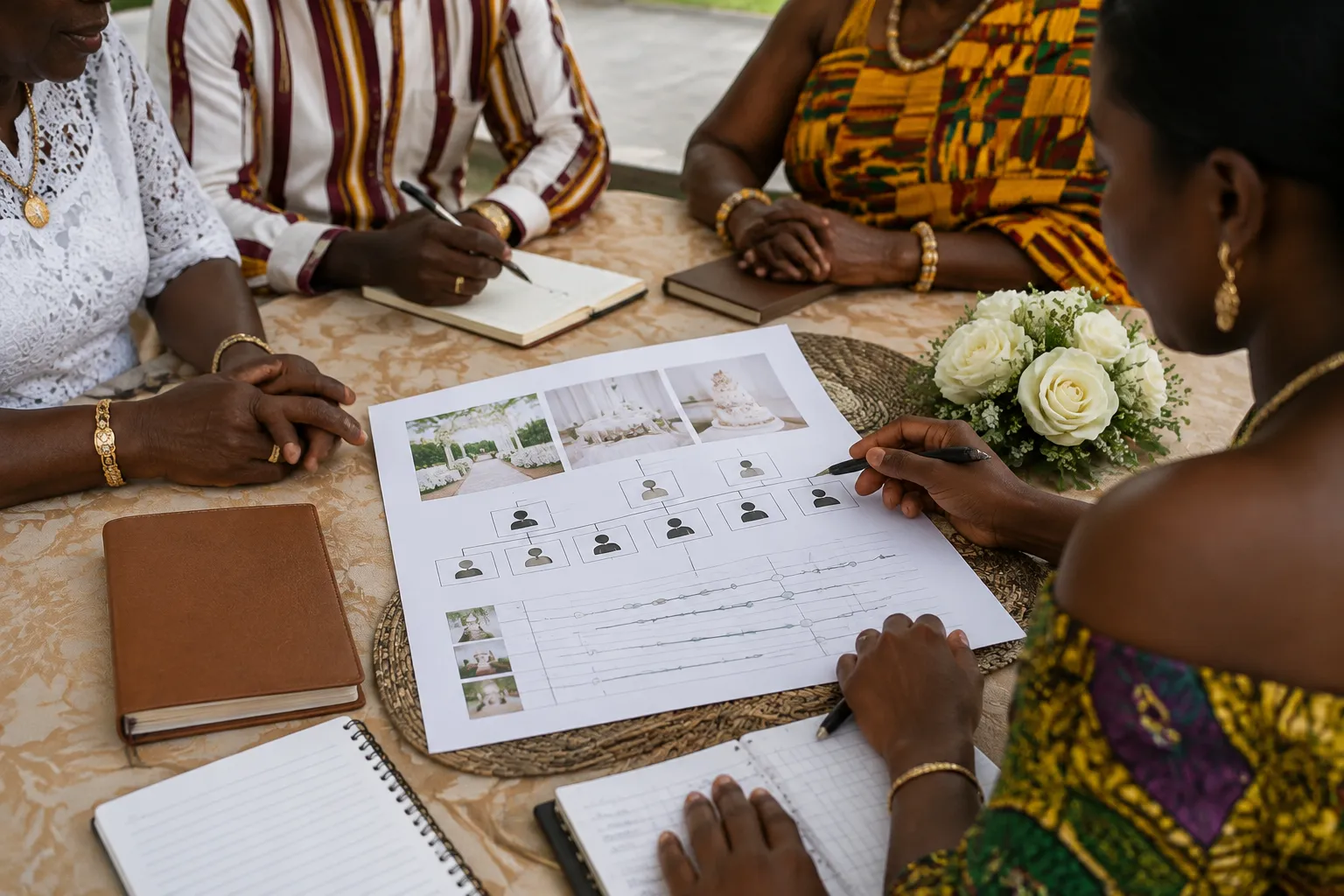
This sheet organizes a conversation; it does not decide which customary engagement practice, knocking ceremony sequence, church arrangement, civil process, or family role applies. Those details can change with family preference, cultural group, faith, location, date, and ceremony type.
Start With the Spokesperson
Record the person who will lead the family discussion or speak on the family’s behalf. The spokesperson may communicate an agreement without owning every practical task, so assign separate people where the handoff matters.
- Family spokesperson:
- Family represented:
- Couple’s names:
- Discussion date and location:
- Backup contact for time-sensitive questions:
- Elder or relative to consult before a new agreement:
Use four status labels when completing the sheet:
- Agreed: the family has confirmed it.
- Proposed: the family is considering it.
- To confirm: another person, institution, venue, registrar, or public authority needs to answer.
- Not applicable: the point does not belong in this family’s plan.
Record the Talking Points
Keep the briefing focused on decisions rather than a general list of wedding topics. For each point, identify the person who can confirm it and separate settled information from open questions.
| Discussion point | Current position | Person who confirms it | Status |
|---|---|---|---|
| Ceremony or meeting being discussed | |||
| Date and start time | |||
| Location and arrival point | |||
| Who will speak first | |||
| Who will respond for the other family | |||
| Items or messages to be presented | |||
| Relatives who need to attend | |||
| Relatives who need an update | |||
| Planner, photographer, or venue handoff | |||
| Unresolved question |
Do not add an item merely because it appears on a general wedding list. Record whether this family requested it, whether both families agreed to it, whether a religious or ceremonial authority suggested it, whether a vendor introduced it, or whether it was added for convenience.
A family preference is different from a commonly observed pattern, a religious procedure, a vendor convention, and a current local requirement. The spokesperson should know which kind of statement they are carrying into the discussion.
Clarify Who Speaks and Who Confirms
A wedding discussion may involve several relatives, but the speaking responsibility should remain clear. Record who opens the discussion, introduces the couple or family, presents questions, responds to the other family, and explains any item or contribution.
Also identify who can pause the discussion for private consultation, who records the outcome, and who confirms the next meeting or action. This prevents a person with a communication role from being treated as the sole decision-maker.
“This is what we understand has been agreed. We will confirm the remaining points with the relevant family members before treating them as settled.”
This wording keeps the briefing accurate when the spokesperson can communicate the family’s position but cannot settle every detail. It also gives elders and other relatives a clear opportunity to correct an incomplete understanding.
Track Items, Messages, and Handoffs
If an item may be presented, brought, received, stored, returned, or transferred between locations, give it one line on the sheet.
| Item or message | Requested or suggested by | Person bringing it | Person receiving it | Where it goes afterward | Confirmed? |
|---|---|---|---|---|---|
The same structure can cover documents, gifts, ceremonial materials, family letters, payments, clothing, food arrangements, or presentation items. It does not establish that any of them are required. It shows who owns an agreed task and where the object or responsibility goes next.
For money, documents, or items connected to a formal process, record the responsible person and confirmation point separately. A verbal assumption is not evidence that a registrar, religious body, venue, or other responsible authority has accepted the arrangement.
Set the Before, During, and After Sequence
A short run of show helps relatives understand when to arrive and when their role ends. Use the family’s agreed sequence rather than copying one from another wedding. A planning reference describes talking points and a run of show as ways to organize messages, timing, participants, and ownership; that structure is useful here, but it does not establish Ghanaian family practice.

Before the discussion or ceremony
- Confirm the date, location, and arrival time.
- Check which relatives need to attend in person.
- Share the approved talking points with the spokesperson.
- Confirm items, documents, or messages that someone has agreed to bring.
- Give the planner, photographer, driver, or venue contact the correct handoff time.
- Mark questions that remain open.
During the discussion or ceremony
- Identify the person responsible for each speaking part.
- Follow the locally agreed order.
- Record decisions as they are made.
- Note any item, date, amount, document, or responsibility that changes.
- Do not announce an unresolved point as though it has been accepted.
- Ask who confirms the next step before the group closes.
After the discussion or ceremony
- Send the recorded decisions to the couple and relevant relatives.
- Assign every follow-up to one named person.
- Confirm the next date, payment, delivery, rehearsal, or appointment.
- Return unresolved cultural questions to the appropriate family spokesperson or elder.
- Check registration questions with the relevant registrar, public authority, religious body, or qualified legal professional for the applicable jurisdiction and current date.
Separate Attendance From Notification
A relative may need the information without being expected to attend. Another person may need to arrive early because they carry an item or speak for the family. Keep those responsibilities on separate lines.
| Relative or group | Needs to arrive? | Needs an update? | Arrival or contact deadline | Responsible person |
|---|---|---|---|---|
| Elder or family representative | ||||
| Couple’s close relative | ||||
| Person bringing an item | ||||
| Religious or ceremony contact | ||||
| Photographer or planner | ||||
| Traveling guest |
For relatives traveling from another city or country, record the practical dependency rather than promising an outcome: who sends the confirmed time, who shares the location, who checks changes, and who communicates a change in sequence.
Keep Customary and Formal Questions Apart
A customary engagement, church ceremony, civil ceremony, and reception may be planned together, but they do not automatically answer the same questions. The sheet should show which matters belong to family agreement and which require current external confirmation.
Family and ceremony questions
- What has each family agreed to discuss or present?
- Who speaks for each side?
- Which relatives should attend?
- What sequence has the family confirmed?
- Which items or responsibilities remain open?
Current formal questions
- Which documents or appointments apply to the planned civil or religious process?
- Which institution confirms the process?
- Does the answer depend on jurisdiction, location, faith, or ceremony type?
- When was the information last checked?
- Who will contact the relevant registrar or qualified professional?
The available material does not provide current Ghanaian evidence for registration steps, customary obligations, requested items, or the legal effect of any ceremony. Keep those questions visible, but route them to the responsible current authority rather than using this briefing sheet to decide a marriage’s status.
Worked Wedding Discussion Handoff
Suppose the couple has agreed that one elder will lead the family discussion, another relative will bring the agreed items, and a third person will update traveling relatives. The sheet should show those three responsibilities separately.
The spokesperson then confirms who opens the discussion, who speaks for the other family, what the relative is bringing, who receives or records it, which relatives need the confirmed arrival time, which questions remain unresolved, and who checks any formal process with the relevant authority.
This is a coordination example, not a Ghanaian ceremony rule. Another family may assign the same responsibilities differently or use a different sequence.
Final Check Before the Discussion
- Is the designated spokesperson named?
- Does every speaking role have a responsible person?
- Does every agreed item have a person bringing and receiving it?
- Are arrival times distinct from notification deadlines?
- Are proposed details separated from settled agreements?
- Are unresolved questions visible?
- Are cultural, religious, vendor, and formal questions routed to the right confirmer?
- Has the final version been shared with the relatives who depend on it?
The sheet is ready when the next conversation is clear: the spokesperson knows what to say, relatives know what they are carrying or confirming, and each unresolved point has a named person responsible for answering it.