Cross-Border Wedding Payments and Vendor Approvals
A family meeting is approaching, but the person discussing an amount may not be the person sending the money. One relative may speak for the family, the couple may confirm the vendor, and a guest abroad may complete the transfer.
For Ghana wedding payments, the useful question is not simply who should pay. It is who can approve this payment, which trusted channel confirms the instruction, and where the handoff will be recorded. Those answers may change between a customary engagement, knocking ceremony, church ceremony, civil ceremony, reception, and related family expenses.
Confirm the arrangement with the relevant family spokesperson, couple, planner, or vendor before sending money. A common sequence is a planning clue, not a rule for every family.

Separate Customary Payments From Vendor Invoices
A customary marriage payment and a wedding vendor invoice may sit within the same budget, but they represent different decisions and different people may hold authority over them.
Bounded research from named Ghanaian settings describes marriage payments as matters negotiated among kin, family representatives, and, in some cases, a marriage intermediary. Research on a Muslim Hausa setting in Accra also describes senior relatives, bridewealth, gifts, and other obligations within the cost of marriage. These accounts help explain why responsibility may sit with senior relatives in one family and with different representatives in another. They do not establish a universal Ghanaian payment hierarchy.
A vendor invoice has a separate practical dependency. The responsible person should be able to confirm the service, amount, due date, recipient details, and any agreed change. The vendor, couple, planner, or assigned family coordinator may each hold part of that information.
Before combining amounts in one transfer, establish:
- Whether the payment covers a customary family item, vendor service, venue, or personal contribution
- Who agreed to the amount
- Who is authorized to approve the transfer
- Whether the recipient is the vendor, a family representative, or another designated person
- Which invoice, booking, ceremony, or family reference belongs with the payment
- Who will confirm receipt
A shared budget can contain all these entries. The approval route for each entry should remain visible.
Assign the Payment Approver for Each Item
The responsible payment approver is the person who can confirm that the amount and recipient match the agreement for that particular payment.
- The couple may approve a service they booked directly.
- A family spokesperson may approve a customary engagement payment.
- An elder may be assigned to confirm a family item or presentation list.
- A relative abroad may coordinate contributions without having authority to change the agreed amount.
- A planner may manage an agreed vendor package.
- A vendor contact may confirm the business payment details for an invoice.
Assign the role for the specific payment rather than assuming one person controls the entire wedding. An elder may approve an engagement item while the couple approves photography. A relative may send the money without approving the recipient or amount.
Record the approval beside the payment entry before the transfer is made. The record can include:
| Payment detail | Confirmation to record |
|---|---|
| Purpose | What the payment covers |
| Amount | Agreed total and currency |
| Approver | Person who authorized the payment |
| Sender | Person or account sending the funds |
| Recipient | Vendor, business, family representative, or other agreed recipient |
| Channel | Bank transfer, mobile money, card, or another agreed method |
| Date | Date the payment was approved and sent |
| Reference | Transaction, invoice, booking, or family reference |
| Receipt | Person who confirmed that the expected funds arrived |
This record does not decide which family practice is appropriate. It shows what this family agreed for this payment.
Verify Changed Vendor Payment Instructions Before Sending Money
A changed vendor instruction deserves a pause, even when the message appears to come from a familiar contact.
Do not rely on the new bank account, mobile-money number, payment link, or message alone. Use a contact route already trusted in the wedding record, such as a previously used vendor number, a known business contact, or a face-to-face confirmation through an assigned relative. The point is to confirm the change independently from the message that introduced it.
The central question is whether the responsible person can confirm that the new instruction belongs to the agreed service and current vendor arrangement. A professional-looking message does not answer that question by itself.
Ask the vendor or assigned coordinator to confirm:
- The vendor or business name
- The person authorized to receive the payment
- The account or wallet details
- The invoice or booking reference
- The amount and currency
- The reason for the change
- Whether the earlier instruction should be disregarded
- How receipt will be acknowledged after payment
Keep the earlier instruction in the record. Mark it as superseded only after the change has been confirmed, so the couple and family can see what arrived, what changed, and who confirmed the new details.

Choose a Trusted Confirmation Route
A trusted payment verification channel is an independent route agreed before money moves. It should not be the same unverified message that introduced a changed instruction.
One family may ask the couple to confirm venue and photography changes through the vendor's previously recorded number, while the family spokesperson handles customary payments. Another may use a planner as the central contact for several vendors and keep family representatives responsible for engagement items.
The choice is family-specific. Record it early enough that a relative abroad knows whom to contact before a deadline becomes urgent.
Please confirm the approved amount, recipient name, payment purpose, and current payment details for this invoice or family item.
The wording can change, but the confirmation should identify the person making the decision and the item being paid. A message that says only “send it here instead” leaves the amount, recipient, and reason unresolved.
When several people are involved, use this handoff:
- The vendor or family representative provides the payment request.
- The assigned approver confirms the amount and purpose.
- The sender checks the recipient details through the agreed contact route.
- The sender completes the transfer.
- The recipient or approver confirms receipt.
- The record keeper stores the confirmation with the transaction reference.
A small contribution may need fewer messages, but the responsible person and the payment purpose should remain clear.
Check the Recipient, Amount, and Record
Ghana-focused payment research describes electronic transaction notices as potentially containing the amount, transaction type, date, time, reference, sender or recipient identification, and fees. Other research distinguishes authentication, which helps confirm access to an account, from checking whether the transaction details are accurate.
For wedding planning, both questions matter. A sender may successfully access an account and still send the wrong amount or select the wrong recipient.
Before confirming a cross-border wedding payment, compare the transfer screen with the approved record:
- Recipient name or registered business name
- Account, wallet, or other destination details
- Amount and currency
- Stated fee or charge, where shown
- Payment purpose
- Invoice, booking, or family reference
- Sender identity
- Expected receipt or transaction reference
An electronic receipt shows what the payment channel recorded. It does not by itself establish that the vendor has reconciled the funds. The vendor or family recipient should separately confirm that the expected amount arrived.
Fees, levies, exchange rates, transfer limits, processing times, and provider requirements can change. Check current information from the relevant bank or payment provider for the route being used. The available research does not establish one current cross-border procedure or provider-specific fee for this page.
Keep the Three Payment Roles Distinct
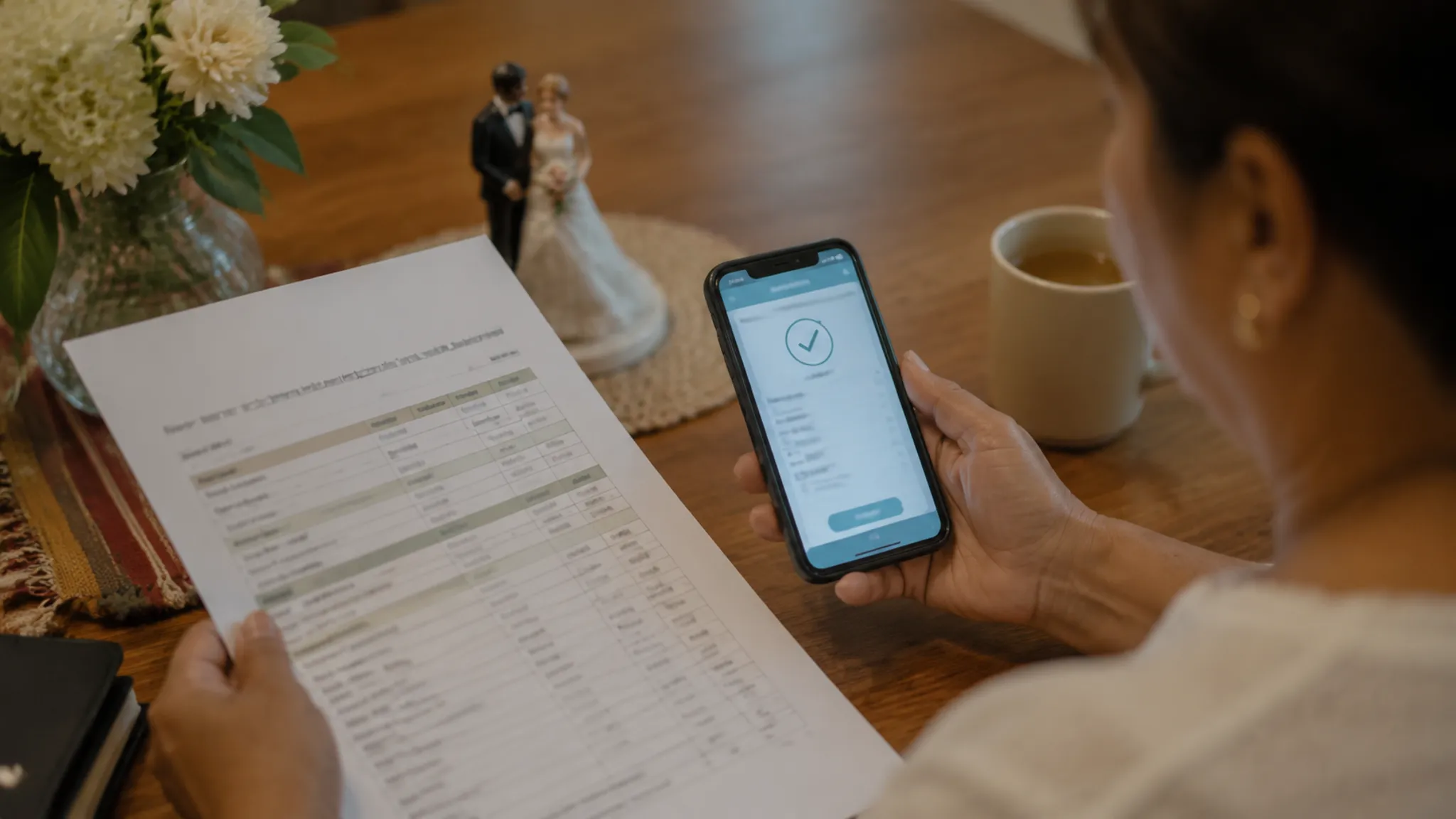
A payment record is easier to interpret when it separates who approved, who sent, and who received the funds.
- Approved by: the person who agreed that the payment should be made
- Sent by: the person who initiated the transfer
- Received or confirmed by: the person or business that acknowledged receipt
These roles may belong to three different people. A parent may approve a customary payment, a sibling abroad may send it, and a family spokesperson may confirm that the receiving side acknowledged it. For a photographer, the couple may approve the invoice, a relative may send the funds, and the photographer may confirm receipt.
Store the transaction receipt with the related invoice, family agreement, or event budget entry. If the decision was made by phone, record the date, participants, and agreed outcome in a short note. Several payments moving between countries and relatives are difficult to reconstruct from memory alone.
Label the payment as a deposit, balance, contribution, customary payment, gift or presentation item, reimbursement, or transfer to a vendor package coordinator. That distinction helps prevent a customary payment from being counted as a service deposit, or a personal contribution from being treated as a vendor balance.
Coordinate Payments Across Ceremony Milestones
Payment responsibility may change as the wedding moves from family negotiation to booked services and ceremony-day expenses. Name the handoff before setting the time.
Before the customary engagement
Confirm which family spokesperson is handling discussions about the knocking ceremony, engagement list, gifts, and presentation items. Research from named Ghanaian settings shows that senior kin, family representatives, and marriage intermediaries can have meaningful roles, but those accounts do not define every family's arrangement.
Record the agreed items and who can approve changes. The person organizing the reception may not speak for the customary engagement.
Between the engagement and the ceremony
The couple or planner may coordinate the venue, attire, photography, accommodation, transport, and other vendors. Assign an approver for each category, especially when relatives abroad are contributing.
Before a vendor payment is sent, the person responsible for that service should confirm the invoice and recipient details. If a planner is collecting money for several vendors, agree how each vendor payment will be identified and acknowledged.
Before the church or civil ceremony
Confirm remaining vendor balances, ceremony-related costs, and any local procedures that affect timing. Civil-registration requirements are jurisdiction- and date-sensitive, and the available material does not establish them for this page. Case-specific status questions belong with the relevant registrar or qualified legal professional.
Keep ceremony payments separate from a formal registration fee or document-related payment unless the responsible institution or coordinator has clearly explained the arrangement.
Before the reception
Reconcile deposits, balances, late changes, and payments made by relatives. A photographer, caterer, decorator, venue, or transport provider may have a different contact person and deadline.
A short payment meeting can settle the remaining handoffs:
- Which invoices are still open?
- Who approved each outstanding amount?
- Which payment details have changed?
- Who will confirm receipt?
- Where is each receipt stored?
- Which items remain family decisions rather than vendor decisions?
When Family Accounts Conflict
Conflicting instructions call for a conversation before a transfer, not a faster transfer.
Pause the payment when:
- Two relatives provide different amounts.
- A vendor sends a new destination without independent confirmation.
- The sender cannot identify who approved the change.
- The recipient name does not match the agreed vendor or representative.
- A customary payment is being described as a service invoice.
- A payment has been sent, but no one can confirm who received it.
- A planner, elder, and couple each believe someone else is responsible.
Ask the family spokesperson or assigned approver to state the current decision in one written message. Attach that message to the payment record.
The resolution may reflect a family preference rather than a general rule. One family may centralize approvals with an elder; another may assign the couple to vendor payments while relatives handle customary negotiations. The useful outcome is a confirmed handoff that the people involved understand.
Worked Payment Handoff
Suppose a relative living abroad is asked to pay a photography balance. The message includes a new account number and asks for payment that day.
The relative first contacts the couple or assigned wedding coordinator through a previously recorded route. The approver confirms that the photographer is still providing the service, checks the balance and currency, and verifies the new destination with the photographer through an established contact.
The relative records the approver, sends the payment, saves the transaction reference, and asks the photographer to confirm receipt. If a different amount arrives, the record shows who approved the original amount, who sent it, and what the recipient reported.
This illustrates a coordination path. It does not show that every Ghanaian wedding uses a photographer, a planner, the same payment method, or the same approval structure.
Questions to Confirm Before Sending
- Who is the responsible payment approver for this item?
- Is the payment customary, personal, or for a vendor service?
- What amount and currency were agreed?
- Who is sending the money?
- Who is receiving it?
- Has the recipient been confirmed through an established contact route?
- Did the payment instruction change?
- What invoice, booking, or family reference belongs with the payment?
- What receipt or transaction reference will be stored?
- Who will confirm that the funds were received?
- Are current provider fees, limits, timing, or other requirements relevant to this route?
- Does a civil or customary registration question need confirmation from the relevant institution?
Final Handoff
A workable Ghana wedding payment plan does not depend on one assumed family hierarchy. It depends on a named approver, a trusted confirmation route, a recipient and amount check, and a record of the handoff.
Keep customary marriage payments separate from vendor invoices. Label the ceremony milestone and the person responsible for the decision. When instructions change, pause and confirm them through a route already trusted by the couple, family, or vendor.
The remaining questions will depend on the family, ceremony setting, payment provider, jurisdiction, and date. Assign each question to the person or institution able to confirm it before the next payment is sent.
Sources
- Assessing the Impact of Mobile Money Interoperability on Small and Medium Scale Enterprises Payments and Receipts in Ghana for bounded context on Ghanaian payment mechanisms and transaction coordination.
- The E-Levy and Merchant Payment Exemption in Ghana for context on changeable payment and levy questions that require current route-specific checking.
- Investigating Challenges of Mobile Money usage in the Central Business District of the Kumasi Metropolitan Assembly, Adum- Ghana for limited, location-specific context on mobile-money use and its practical constraints.
- Marriage, bridewealth and power: critical reflections on women's autonomy across settings in Africa for comparative context on negotiated marriage payments and the limits of generalizing across settings.
- Getting married and the making of manhoods in a Ghanaian Zongo for a bounded ethnographic example of family and marriage negotiations in a named Ghanaian setting.
- M-19-03: Expenditures made using peer-to-peer payment applications for comparative recordkeeping language only, not as evidence of Ghanaian wedding-payment requirements.
These sources support mechanisms, comparative framing, or bounded examples. They do not establish a universal Ghanaian family payment hierarchy, a current provider procedure, a formal registration requirement, or a guaranteed outcome for a transfer or vendor dispute.