Diaspora Wedding Guest Communication and Itineraries

A destination wedding itinerary has to answer more than “when is the ceremony?” Guests arriving from different countries also need to know what has been confirmed, who owns each update, and which details they must verify for themselves.
That becomes more involved when a Ghana wedding includes a customary engagement, knocking ceremony, church ceremony, civil ceremony, reception, welcome gathering, or farewell event. A family may combine some occasions, hold them on different days, or leave them outside the guest program. Record the agreed plan rather than assuming that one Ghanaian sequence applies to every family.
For each detail, ask: what does the guest need, who confirms it, when is it sent, and what changes if it remains unconfirmed?
Start With the Guest’s Travel Decision
Diaspora guests often arrange flights, accommodation, leave from work, transfers, attire, and family commitments before the full wedding program is ready. The first communication should therefore separate information into four practical groups.
- Travel information: arrival and departure dates, airport, accommodation, and transfer needs.
- Confirmed wedding events: occasions that the couple or family has agreed to include.
- Optional activities: gatherings, excursions, or free-time suggestions that guests may attend.
- Independent checks: immigration, health, security, airline, transit, and route information that each traveler verifies for their own circumstances.
The couple or planner can gather responses and publish revised details. The family spokesperson should confirm ceremony information and expected attendance. A transport coordinator should confirm movement between airports, accommodation, venues, and events.
Each guest remains responsible for checking travel information related to their nationality, purpose, route, transit points, and date of travel. A wedding itinerary is a coordination record, not a substitute for traveler-specific guidance or family agreement.

Build a Travel Information Form for Diaspora Wedding Guests
A travel information form for wedding guests should collect only what is needed to coordinate arrival, accommodation, events, and practical support. Use a private form or controlled process for operational details rather than placing them on a public itinerary page.
| Information to collect | Why it matters | Who reviews it |
|---|---|---|
| Guest name and preferred contact method | Identifies the traveler and the best channel for updates | Couple or planner |
| Country of departure | Helps the guest locate relevant travel guidance | Guest, with planner tracking completion |
| Arrival and departure dates | Shows the guest’s travel window | Couple or planner |
| Arrival airport and flight details | Supports airport coordination and pickup planning | Transport coordinator |
| Accommodation name and address | Connects the traveler to a pickup point and local contact | Guest and transport coordinator |
| Transfer requirement | Shows whether arranged movement is needed | Transport coordinator |
| Accessibility or medication-storage logistics | Allows practical support without collecting unnecessary health information | Private coordination contact |
| Emergency contact | Provides a contact point for an urgent operational matter | Couple or planner |
| RSVP status for each event | Separates expected attendance from undecided plans | Couple or family spokesperson |
| Questions requiring a family response | Captures dress, timing, participation, or ceremony questions | Family spokesperson |
Do not request passport numbers, full medical histories, or other unnecessary personal information in a general guest form. A guest may need to discuss accessibility or medication storage privately, but those details should not appear in a shared itinerary.
Give each response a clear status: received, needs clarification, confirmed, or not applicable. This helps the couple or planner find open handoffs before the final schedule is issued.
Assign One Responsible Contact for Each Information Type
A diaspora wedding guest itinerary becomes difficult to use when every question goes to the couple, or when no one knows who can confirm an answer. Assigning ownership makes the next conversation visible.
The couple or planner
- Gather guest travel information.
- Maintain the guest list and RSVP record.
- Publish the destination wedding itinerary.
- Share accommodation and venue information.
- Issue revised schedules.
- Collect questions that need a family response.
- Mark which details remain provisional.
A planner may coordinate the process, but should not decide family customs or a traveler’s entry eligibility.
The family spokesperson
The family spokesperson should confirm whether a customary engagement or knocking ceremony is included, whether a church or civil ceremony forms part of the program, and which gatherings are expected, invited, or optional.
This person should also answer questions about dress guidance, photography, greetings, presentations, and family participation. References to Akan, Ga, Ewe, Northern, or multicultural traditions can help identify questions to ask. They do not establish what this couple’s wedding will include.
The transport coordinator
The transport coordinator should confirm the pickup location, guest pickup time, vehicle departure time, destination address, group movement plan, accommodation contact, accessibility arrangements, late-arrival process, and contingency contact.
Pickup time and vehicle departure time are different details. A guest may need to reach a meeting point before the vehicle leaves, so both times should appear in the itinerary.
Each guest
Each traveler should independently check passport and entry information, visa or entry authorization information relevant to their nationality and route, transit-country conditions, airline requirements, destination information, travel advisories, and return or onward travel details where relevant.
Hosts can point guests toward current sources, but should not determine eligibility or provide individualized legal or health guidance. Requirements may vary by nationality, travel purpose, route, transit history, and date.
Separate Confirmed Events From Optional Activities
Guests need to know whether an event is part of the expected wedding program, an invitation, or a suggestion. Use three labels:
- Expected: The couple or family has confirmed that the guest should attend.
- Optional: The activity is available, but attendance is not treated as an expected commitment.
- Unconfirmed: The event has been discussed but lacks a confirmed time, location, or responsible contact.
This distinction matters when several days of activity are planned. A welcome gathering may be expected for some guests and optional for others. A customary engagement may be central to the family program without being open to every traveling guest. A farewell brunch may depend on departure times and accommodation locations.
Do not place an event in the confirmed itinerary merely because it is common at another wedding, appears in a generic checklist, or was mentioned informally in a family chat.
For each confirmed event, translate the family decision into guest instructions:
- Where should the guest arrive?
- What time should the guest arrive?
- What dress guidance has been requested?
- Is transport supplied?
- Who answers questions about participation?
- What happens if the ceremony timing changes?
Use a Ghana Wedding Guest Itinerary With Status Fields
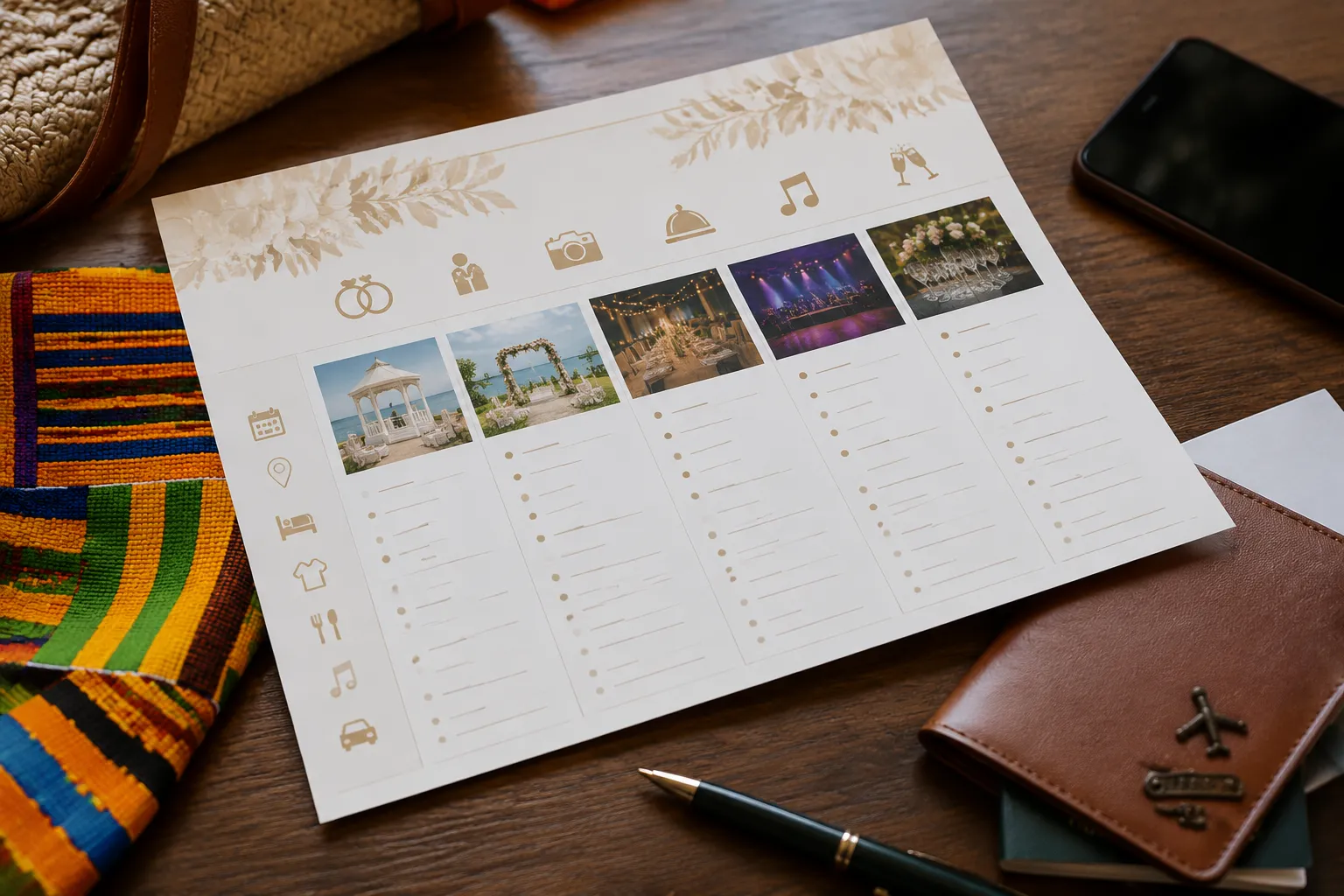
A Ghana wedding guest itinerary can remain easy to scan while showing uncertainty. The following is a planning example, not a universal Ghanaian format.
| Date | Event | Location | Guest arrival or pickup time | Dress guidance | Responsible contact | Status |
|---|---|---|---|---|---|---|
| Friday | Arrival and accommodation check-in | Confirmed accommodation | Guest-specific | Travel clothing | Accommodation contact | Confirmed |
| Saturday | Welcome gathering | Family-confirmed venue | To be confirmed | Family guidance pending | Family spokesperson | Needs clarification |
| Sunday | Customary engagement or knocking ceremony | Family-confirmed location | Confirmed arrival time | Confirm with family spokesperson | Family spokesperson | Confirmed |
| Monday | Free time or optional activity | Guest-selected | No group pickup | No event guidance | Couple or planner | Optional |
| Tuesday | Church or civil ceremony | Confirmed ceremony venue | Guest arrival time | Confirm with couple | Couple or planner | Confirmed |
| Tuesday | Reception | Confirmed reception venue | Transport departure time | Reception guidance | Transport coordinator | Confirmed |
| Wednesday | Departure transfers | Airport or agreed pickup point | Guest-specific | Not applicable | Transport coordinator | Pending flight details |
Each row should describe what the guest needs to do, not only what the hosts are organizing. “Reception, 2:00 p.m.” is incomplete without the venue address, guest arrival time, dress guidance, transport contact, and confirmation status.
Communicate in Milestones, Then Reissue the Details
International guests benefit from staged communication because the family program, accommodation, and transport arrangements may not be settled together.
First communication: travel window
Share the wedding date, expected travel window, destination area, RSVP process, and the person collecting guest information. Avoid presenting provisional ceremony details as final.
Ask guests for arrival and departure dates, airport information, accommodation plans, transfer needs, and questions about the family program.
Second communication: accommodation and event structure
After the couple, planner, and family spokesperson have confirmed more of the program, send accommodation details, airport and transfer information, expected and optional events, venue locations, dress guidance, RSVP deadlines, and the date of the next update.
If accommodation is arranged in more than one place, give each location a responsible contact. Guests should not have to infer who handles a late arrival, missed pickup, or change of accommodation.
Third communication: pre-departure confirmation
Before guests travel, reissue the itinerary with the latest confirmed information. Include arrival and departure dates, airport details, accommodation address, transfer instructions, pickup and vehicle departure times, venue addresses, event status, dress guidance, emergency contact, and outstanding guest checks.
Mark changes clearly. A revised itinerary should show what moved, what remains provisional, and who approved the change.
Arrival communication: the next handoff
At arrival, repeat the operational details guests need first: accommodation location, local contact, first confirmed event, pickup instructions, transport meeting point, and emergency contact.
This short message does not replace the full itinerary. It makes the next handoff obvious for guests who have crossed time zones, changed devices, or arrived at different times.
Keep the Immigration Verification Checklist Narrow
Travel verification belongs in the itinerary as a responsibility and a prompt, not as a universal answer. Each guest can record the date of their own checks.
- Is my passport acceptable for the intended journey?
- Do I need a visa or other entry authorization for my nationality?
- Does my travel purpose affect the process?
- Do my transit countries impose additional conditions?
- Do I need to confirm onward or return travel information?
- Are there current destination or health checks relevant to my route?
- Have I checked the latest Ghana Immigration Service guidance?
- Have I checked my embassy or consular guidance?
- Have I recorded when I completed these checks?
A dated Ghana visa-on-arrival page can prompt further investigation, but a 2025 page should not be treated as current without checking the latest guidance. It also does not show that every traveler is eligible or that the same documents, duration, or process applies to every nationality.
Ghana destination-health guidance may help a guest identify questions for an appropriate health professional. The itinerary should avoid universal conclusions about vaccinations, Yellow Fever documentation, medication, or route-specific health decisions. A traveler’s origin, transit route, activities, and individual circumstances can affect what needs to be checked.
Give Dress Guidance Without Turning It Into a Cultural Rule
Wedding itinerary dress guidance should record the family’s request in practical language. For example:
- “Family guidance on traditional cloth: confirm by [date].”
- “Guests attending the customary engagement should ask the family spokesperson about requested attire.”
- “Kente is a possible reference point, but no assumption is made about whether it forms part of this wedding.”
- “Church ceremony and reception guidance will be issued by the couple.”
This gives the family room to explain whether guests should wear a particular color, fabric, formal style, or level of coverage. It also avoids presenting Kente, durbar pageantry, a knocking ceremony, or another cultural element as required for every Ghanaian wedding.
The responsible contact should answer what is appropriate for this particular event. A generic image or checklist cannot settle a family-specific request.
Plan Transfers Around Confirmation Points
Transportation information should connect a guest, place, time, and responsible person. A complete transfer line may include:
- Guest or group name
- Pickup location
- Pickup time
- Vehicle departure time
- Destination
- Driver or coordinator contact
- Late-arrival instructions
- Accessibility note where relevant
- Confirmation status
Airport and accommodation details should be checked against the guest’s actual arrival and departure dates. A guest arriving after the main group may need a different arrangement, while a guest staying outside the main accommodation may need another pickup point.
These are coordination dependencies, not assumptions about local transport performance. The transport coordinator should tell the couple or planner when a route, pickup point, vehicle arrangement, or timing changes. The planner can then issue the revised information to affected guests.

Record Confirmation Status, Not Just Final Answers
A schedule can appear complete while several decisions remain unresolved. Add a status to each major itinerary item:
- Confirmed: The responsible person has approved the detail.
- Pending family confirmation: The possibility exists, but the family spokesperson has not settled it.
- Pending guest response: The event or transfer is confirmed, but the guest has not answered.
- Pending travel verification: The host has provided a prompt, while the guest still needs to check personal travel conditions.
- Changed: Earlier information has been replaced.
- Optional: The guest may attend without treating it as an expected wedding commitment.
This prevents a common mix-up: treating an RSVP as proof that ceremony details are settled, or treating a family discussion as proof that an event has been scheduled.
What This Itinerary Can and Cannot Confirm
A well-maintained itinerary can confirm the events approved by the couple and family, who is expected or invited, where and when guests should arrive, whether transport is being arranged, who handles each question, which details remain pending, and what each guest needs to verify independently.
It cannot confirm entry approval for every traveler, visa eligibility across nationalities, current health conditions for every route, transport performance, family agreement that has not been given by the spokesperson, one universal Ghanaian ceremony sequence, or legal status and registration outcomes.
The available material supports verification pathways and planning fields more strongly than detailed claims about Ghanaian ceremony order, family communication norms, local transport reliability, or universal guest behavior. Keep those areas family-confirmed and date-specific.
Final Handoff Before Guests Travel
Before departure, the couple or planner should be able to answer five questions for every traveling guest:
- What information has this guest supplied?
- Which events are expected, optional, or still unconfirmed?
- Who is responsible for the next handoff?
- When was the latest itinerary issued?
- Which travel details must the guest still verify independently?
The result is more useful than a long generic destination wedding itinerary. It gives the diaspora guest a clear next action, gives the family a defined confirmation point, and shows the planner where an unresolved answer could affect arrival, attendance, transport, attire, or ceremony timing.
Sources
- Ghana Immigration Service
- How to Acquire a Visa on Arrival to Ghana (2025 Guide) – GIS
- Ghana Traveler View
- Ghana Travel Advisory | Travel.State.gov
- Exploring Diasporic Information Needs for the “Motherland”
- African diaspora tourism - How motivations shape experiences
- Event Plan: Finnish-Singaporean Cross-cultural Wedding
- Wedding plan for a New Year´s themed wedding in Porvoo, Finland