Delay and Partial-Attendance Contingency Planning
When a key participant’s flight to Ghana is delayed, the first decision is not whether to cancel the wedding program. Identify the next milestone that depends on that person, who can authorize a change, and when the decision must be confirmed.
A useful wedding contingency plan separates the program into distinct units: customary engagement, church ceremony, civil or registration appointment, photographs, reception, speeches, and family gatherings. The same person may be essential to one unit but only socially important to another.

Before changing the schedule, record four points:
- The participant’s exact role at each affected milestone
- The person authorized to approve a substitute, delay, or reordered program
- The participant’s latest useful arrival time
- The deadline for notifying relatives, vendors, and guests
This keeps an uncertain flight from placing the entire program on hold when only one ceremony moment is affected.
Separate the Flight Delay From the Wedding Decision
Treat transport recovery and the wedding response as connected but separate problems. The operating carrier handles itinerary questions. The couple, family spokesperson, officiant, registrar, planner, and affected vendors determine what can happen at the wedding.
Assign one person to monitor the traveler’s confirmed status. That person should record the operating carrier, revised itinerary, connection status, baggage position when known, and realistic arrival estimate. A second person can communicate the agreed response to relatives and vendors.
- Travel-status monitor: Confirms the itinerary and the next update time.
- Family decision owner: Decides whether the affected family moment waits, proceeds, or uses an agreed representative.
- Program lead: Reorders the schedule and briefs the master of ceremonies and vendors.
- Guest-update contact: Communicates changes to arrival, transport, seating, or meal timing.
- Traveler contact: Tells the participant where to report after arrival and which duties remain.
This division limits contradictory messages. It also prevents the traveler from managing family discussions while trying to rebook or make a connection.
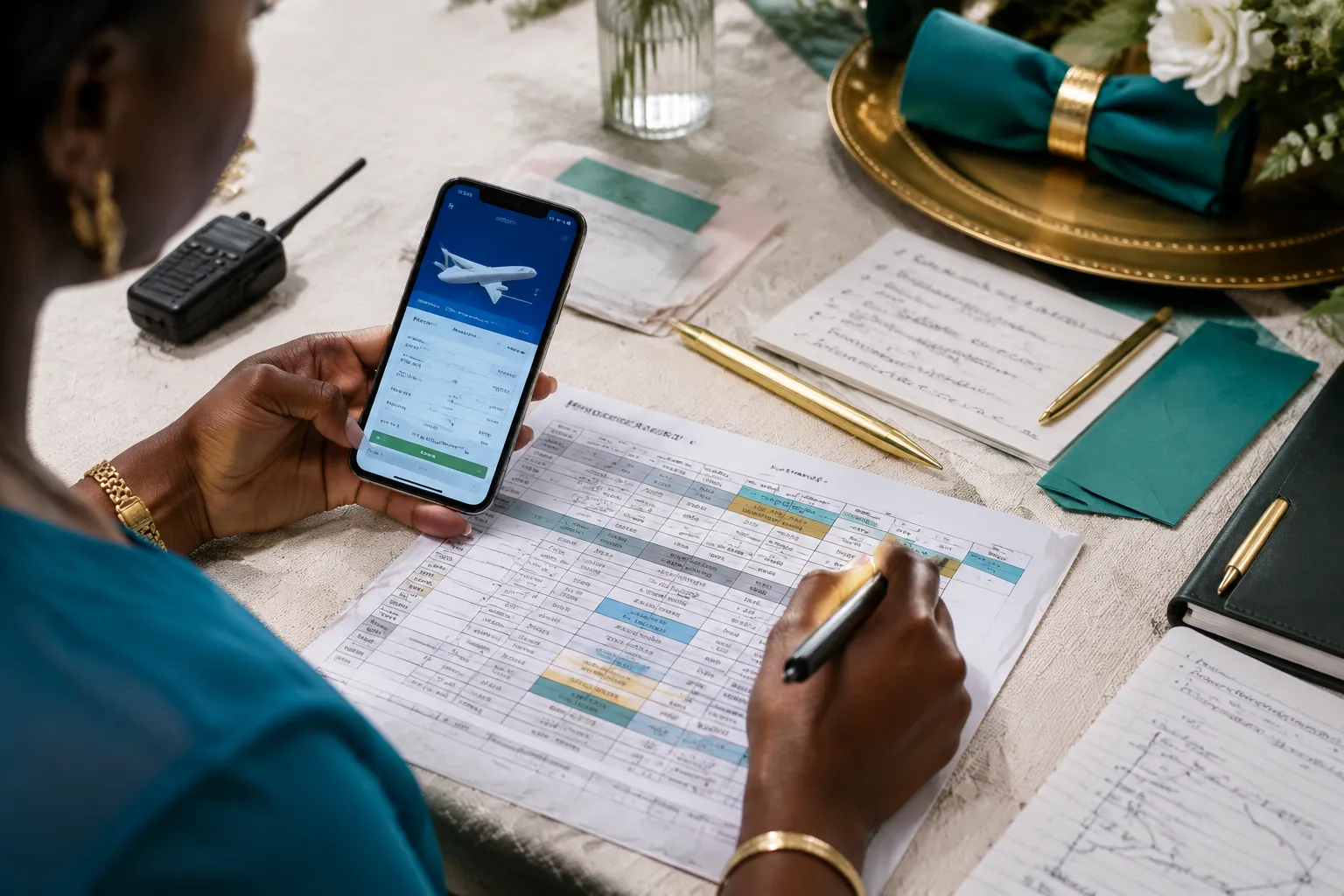
Classify the Participant’s Role
Calling someone “important” does not reveal what their absence changes. Classify the role before deciding whether a milestone can proceed.
Party to a formal appointment
The delayed person may be expected at a registration or certificate-signing appointment. Attendance, witness, document, notice, and rescheduling procedures can differ by municipality and appointment type.
Do not assume that a relative can take the person’s place. Ask the registrar responsible for that appointment who is expected to attend and whether any change is accepted.
Designated witness
A witness may be connected to a formal appointment, a family agreement, or a ceremonial moment. Those functions are not interchangeable.
One university-hosted account of a ceremony in Swedru describes uncertainty when a planned witness arrived late. It illustrates a timing dependency, but one account cannot establish that the witness was indispensable or that the same arrangement applies elsewhere.
The useful question is narrow: for this milestone, is the named witness required, and who can approve a change?
Family spokesperson or elder
Some customary engagement arrangements involve elders, representatives, presentations, negotiations, or a spokesperson. Names and responsibilities vary among families and cultural groups.
Ask whether the delayed person is expected to speak, hand over an item, receive a presentation, introduce relatives, or confirm an agreement. Then establish whether the family recognizes another person for that exact responsibility. A substitute is a family decision, not merely a scheduling convenience.

Ceremonial participant
A participant may have a procession, prayer, reading, introduction, escort, presentation, or speech. These contributions may be easier to move than formal or family-authority roles, but the responsible family or faith leader should still agree to the change.
The contribution might move later, pass to an accepted substitute, become a recorded message, or leave the program. Choose the response before the master of ceremonies announces the item.
Operational helper
A relative may carry attire, rings, gifts, printed materials, payment records, keys, or equipment needed by another person. Here, the object can be a tighter dependency than the traveler’s title.
Confirm where the item is, whether someone else can collect it, and whether the affected vendor can proceed without it. Reassigning the role does not help if the required object remains in delayed baggage.
Socially important guest
A parent, sibling, relative, or friend may matter deeply to the couple without holding a required role in the next milestone. The program may proceed while preserving a later welcome, speech, photograph, or private family moment.
The choice can still be difficult. This classification only distinguishes emotional importance from an operational or procedural dependency.
Set the Latest Useful Arrival Time
A scheduled landing time is not a useful arrival time. Allow for arrival processing, baggage collection, ground transport, changing clothes, collecting materials, and reaching the current venue.
- Start with the time the participant needs to be ready, not merely present.
- List the steps between aircraft arrival and ceremony readiness.
- Remove or reassign any step that does not require the traveler.
- Add a buffer before the dependent milestone.
- Set a decision deadline before relatives, guests, or vendors need instructions.
No single buffer fits every Ghana wedding program. Airport conditions, baggage, traffic, venue location, attire changes, and the participant’s responsibilities all alter the calculation.

A guest assigned only an evening speech may still arrive usefully after missing morning photographs. A family spokesperson expected for an earlier presentation has a different threshold. Someone expected at a formal appointment needs an answer from the responsible institution, not a family estimate.
If the traveler cannot be ready by the recorded threshold, the decision owner will confirm whether the milestone proceeds, moves, or uses the alternate already discussed.
Write that threshold into the plan before departure. During a disruption, it provides a decision point rather than another round of speculation.
Choose a Response for Each Milestone
A delayed wedding participant does not require one response for the entire day. Select an option for each affected unit.
| Response | Use when | Confirmation owner | Main consequence |
|---|---|---|---|
| Proceed | The person is not required for that milestone | Couple and relevant ceremony or family lead | Keep the schedule and arrange a later welcome |
| Substitute | An alternate may be accepted for the exact role | Family spokesperson, officiant, registrar, or responsible lead | Brief the alternate and update names, objects, and cues |
| Reschedule | The unit cannot meaningfully proceed without the person | Person controlling the ceremony unit or appointment | Reconfirm the venue, vendors, relatives, and applicable procedure |
| Reorder | Independent activities can continue while one item waits | Couple, planner, family lead, and affected vendors | Protect guest hospitality while preserving the delayed item |
| Join remotely | A remote contribution is acceptable and practical | Couple and the person controlling the milestone | Assign an operator, joining time, and backup |
| Omit and recover later | The item is optional or can be recreated | Couple and affected participant | Arrange later photographs, remarks, or family time |
The response can change during the day. A speech might move to a later reception segment, while a family presentation may require a decision before guests are seated.
Use a Milestone Handoff Plan
Before departure
Record the traveler’s itinerary, operating carrier, booking reference, contact details, arrival transport, accommodation, and carried objects. When appropriate, keep relevant copies with someone already in Ghana.
Describe each role precisely. “Important uncle” is not actionable. “Family introduction at the customary engagement, dinner speech, and Saturday photographs” shows which decisions may be affected.
When a delay is reported
The travel-status monitor should verify the update through information available for that itinerary. A forwarded message or unconfirmed estimate should not trigger major program changes by itself.
The next update should state the traveler’s location, revised arrival estimate, connection position, baggage status when known, and the next confirmation time. The communication lead then compares that information with the threshold for the next milestone.
At the decision deadline
The named owner selects the prepared response. Avoid reopening every ceremony decision with a large family group while vendors and guests wait.
The participant will miss the family photographs but is expected before the reception. Photographs will proceed with available relatives, and the photographer will hold a later group session if the participant arrives before the reception threshold.
This record identifies what is missed, what continues, who acts next, and when the plan will be reviewed.

After arrival
Direct the traveler to the current venue or accommodation, not automatically to the location on the original schedule. Tell them what has happened, which role remains, and whether their attire or carried items are still needed.
Do not try to recreate every missed moment immediately. First protect the remaining milestone with the tightest dependency.
Place Buffers Where Decisions Can Change
Buffers help most between activities that depend on one another. Spare time at the end of the reception cannot protect an earlier presentation or ceremony start.
- Airport arrival to ground transport
- Ground transport to accommodation or changing location
- Dressing to family presentation
- Family presentation to photographs
- Photographs to guest seating
- Guest seating to ceremony start
- Ceremony end to venue transfer
- Venue transfer to speeches or meal service
A buffer is decision space, not simply unused time. It allows the couple and responsible lead to wait, proceed, or reorder without immediately disrupting the next unit.
Research from Winneba examines customary, church, and reception-related programs as distinct marriage-event units involving different stakeholders and costs. The study is locally bounded and does not establish one Ghanaian sequence, but it supports planning separate dependencies rather than treating the wedding as an indivisible event.
Plan for Partial Attendance
A partial-attendance plan begins with the milestones the traveler can still attend. Divide the program into three groups:
- Missed: Moments that will occur before the participant can realistically arrive
- Recoverable: Photographs, speeches, greetings, or presentations that may move with agreement
- Still available: Units the participant can attend without further schedule changes
This distinction is useful when the customary engagement, church ceremony, registration procedure, and reception occur at different times or on different days. Missing one event does not automatically settle participation in the others.

Photographs
Ask the photographer which group combinations depend on the delayed person. Complete independent combinations on schedule, then reserve a later opportunity for the missing group if time allows.
Speeches
Move a speech only after the master of ceremonies, catering contact, and entertainment lead have agreed on the new position. If it cannot happen, another person may acknowledge the traveler without claiming to speak on their behalf.
Presentations and gifts
Confirm both authority and possession. The family may accept another presenter, but the plan still fails if the item is unavailable or held in delayed baggage.
Use Remote Participation Selectively
Remote participation can preserve a greeting, prayer, speech, or view of the ceremony. Do not assume it replaces physical attendance, a signature, a witness, or a family-authority role.
For an accepted remote contribution, assign a device operator, traveler contact, joining time, short contribution window, powered location, and recorded backup. Test the connection before introducing the participant.
Family preference also matters. Relatives may welcome a remote greeting but decline a screen during a sensitive negotiation or presentation. Agree on that boundary before the ceremony begins.
Keep Travel Remedies and Ceremony Authority Apart
Rebooking, rerouting, refunds, meals, lodging, baggage assistance, compensation, and insurance reimbursement are itinerary-specific questions. Available options may depend on the carrier, route, ticket structure, disruption cause, delay duration, jurisdiction, and terms applying at the time.
The Ghana Civil Aviation Authority provides a public verification point for passenger-rights questions within its scope. If a United States segment or jurisdiction is relevant, United States Department of Transportation material may also apply. For a current disruption, the traveler should check with the operating carrier and the public authority relevant to the itinerary.
Keep the original and revised itineraries, receipts, travel documents, and carrier communications. Those records may support a later transport question, but they cannot authorize a substitute spokesperson or determine whether a wedding milestone waits.
Separate Registration From the Family Program
A customary engagement, registration appointment, civil or ordinance procedure, church ceremony, and reception may involve different people, institutions, documents, and timing dependencies.
Accra Metropolitan Assembly and Ga West Municipal Assembly publish local marriage-registration information. These municipal pages are procedural leads for their jurisdictions, not a single nationwide process. Confirm the appointment, attendance, witness, document, rescheduling, and substitution details with the registrar handling the case.
An absence from a family celebration, church ceremony, reception, or registration-related appointment does not by itself establish a marriage’s status. Questions about a particular case should go to the responsible registrar or a qualified legal professional.
Common Planning Mix-Ups
“The flight is delayed, so the wedding has to wait”
The flight status does not decide the ceremony response. The participant’s role, the affected milestone, and the authorized decision owner determine what can proceed.
“A close relative is automatically required”
Social importance and procedural necessity are different. Record the person’s exact function instead of relying on a family title.
“Any elder can replace another elder”
Families may assign authority differently. Establish who may speak, present an item, receive relatives, or represent the delayed person.
“A new flight solves the wedding schedule”
A revised itinerary may improve the arrival estimate, but the program still needs a decision deadline and communication handoff.
“Remote attendance replaces physical attendance”
It may work for a greeting or speech. Formal, ceremonial, and family-authority roles require separate confirmation.
“One municipal process applies throughout Ghana”
Published registration procedures are jurisdiction-specific and can change. The responsible registrar is the confirmation point for the scheduled appointment.
Record the Decision
| Planning field | Confirmation to record |
|---|---|
| Participant | Name and reachable contact |
| Ceremony role | Exact action at each milestone |
| Role category | Formal, witness, family authority, ceremonial, operational, or social |
| Affected milestone | First unit that depends on arrival |
| Latest useful arrival | Time the participant needs to be ready |
| Decision deadline | Time the responsible person selects a response |
| Decision owner | Family spokesperson, couple, officiant, registrar, or program lead |
| Agreed response | Proceed, substitute, reschedule, reorder, remote, or omit |
| Objects involved | Attire, gifts, documents, rings, payments, or equipment |
| Communication lead | Person updating relatives, vendors, guests, and the traveler |
| Recovery plan | Later photograph, speech, presentation, or family gathering |
| Next checkpoint | Time and source of the next confirmed update |
Use this record for travelers whose absence would change a milestone, not for every guest. Before the program begins, the couple, relevant family representative, and program lead should agree on the first dependency, decision owner, arrival threshold, response, and communication handoff. Later scheduling and vendor instructions can then follow one recorded decision.