Terminology and Ceremony Expectation Alignment
When one family says “knocking” and another says “traditional engagement,” they may be naming different milestones. One side may expect a private family introduction, while the other may be preparing for presentations, a larger guest list, photography, and a family handover.
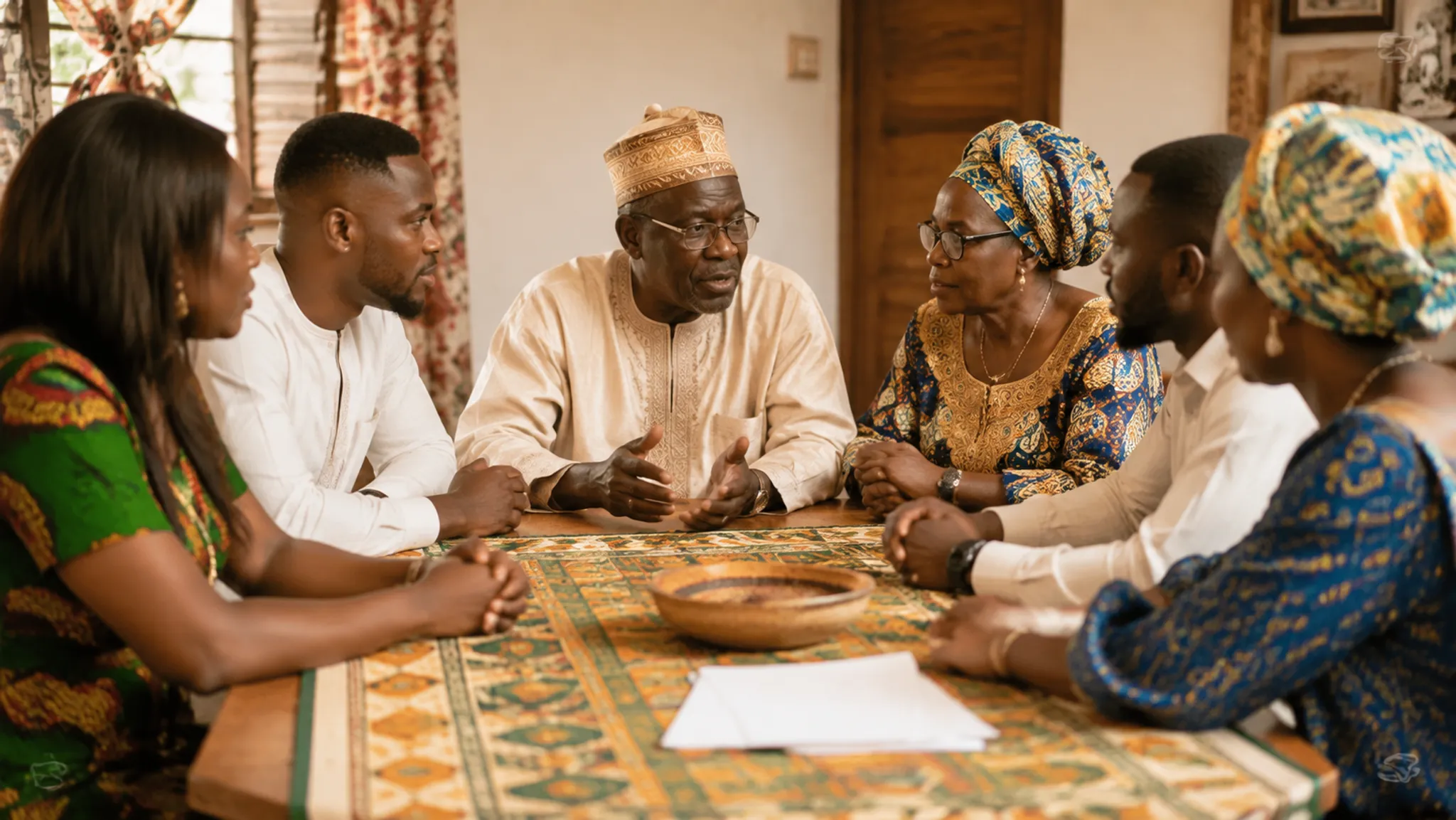
Do not settle the difference by searching for one nationwide definition. Ask each family spokesperson what the event includes, who attends, who speaks, what may be presented, and whether another ceremony follows. The couple can then turn those answers into dates, responsibilities, and clear handoffs.
More specific pages
These pages continue the topic in smaller, more specific directions.
Knocking vs. Traditional Engagement: What Does Each Family Mean?
The useful question is not which label is universally correct. It is what each family expects to be completed under that label.
Some families may use “knocking” for an initial approach between families. The meeting can introduce the couple’s intention, open communication between relatives, and prepare for a later customary engagement. Other families may use the term more broadly for an introduction, a request for consent, discussion of presentation items, or several actions completed during one visit.
A traditional engagement may be a separate ceremony, a larger version of the same meeting, or another name for the main customary event. Research from Anlo and Krobo settings describes different stages and sequences. Those studies provide useful local examples, but they do not establish what another family means.
“When our family says this ceremony is complete, we mean that the following people have met, the following actions have occurred, and the following commitment has been acknowledged.”
Ask both sides to complete that sentence. Their practical description is more useful for planning than the label alone.
Why Ghanaian Wedding Terms Become Ambiguous
Ghanaian wedding terminology alignment becomes difficult when a familiar word carries several layers of expectation. Family practice, cultural group, faith, location, and registration context can each change how a term is used.
One label may cover several family stages
A relative may use “knocking” for the first contact between families. Another may use it for the period between that approach and the customary engagement. If the couple records only the word, they may think a date has been agreed when the families have agreed only to begin discussions.
Replace the label with observable milestones:
- The families have been introduced.
- The couple’s intention has been presented.
- The relevant family representatives have responded.
- Requested items have been discussed or received.
- A later ceremony date has been proposed.
- Responsibility for the next contact has been assigned.
Not every family will use every milestone. The list reveals what has been agreed and what remains open.
“Traditional engagement” may describe different event sizes
For one family, a traditional engagement may be a contained meeting led by elders and family spokespersons. For another, it may be a substantial celebration with invited guests, coordinated attire, food, music, photography, and a reception-style programme.
That difference affects the venue, budget, guest communication, vendor schedule, and time required for presentations. Before booking services, confirm whether “engagement” means a family rite, a public celebration, or both on the same day.
“Wedding” may conceal parallel ceremonies
Some Ghanaian couples plan customary, church, ordinance, registry, or civil events alongside one another. Families and faith communities may not treat these events as interchangeable, even when someone casually calls all of them “the wedding.”
Ask the speaker to name the event:
- customary engagement
- church ceremony
- civil or registry appointment
- reception
- family thanksgiving or related gathering
- a combined event containing more than one component
Once the event is named, the couple can identify who requested it, who controls its programme, and what has to happen before the next ceremony begins.
Compare Ceremonies by Content, Not by Name
A short ceremony record helps both families compare expectations without debating terminology in the abstract. The answers should come from relatives authorized to speak for each family. A planner can organize the information, but should not decide what the terms mean.
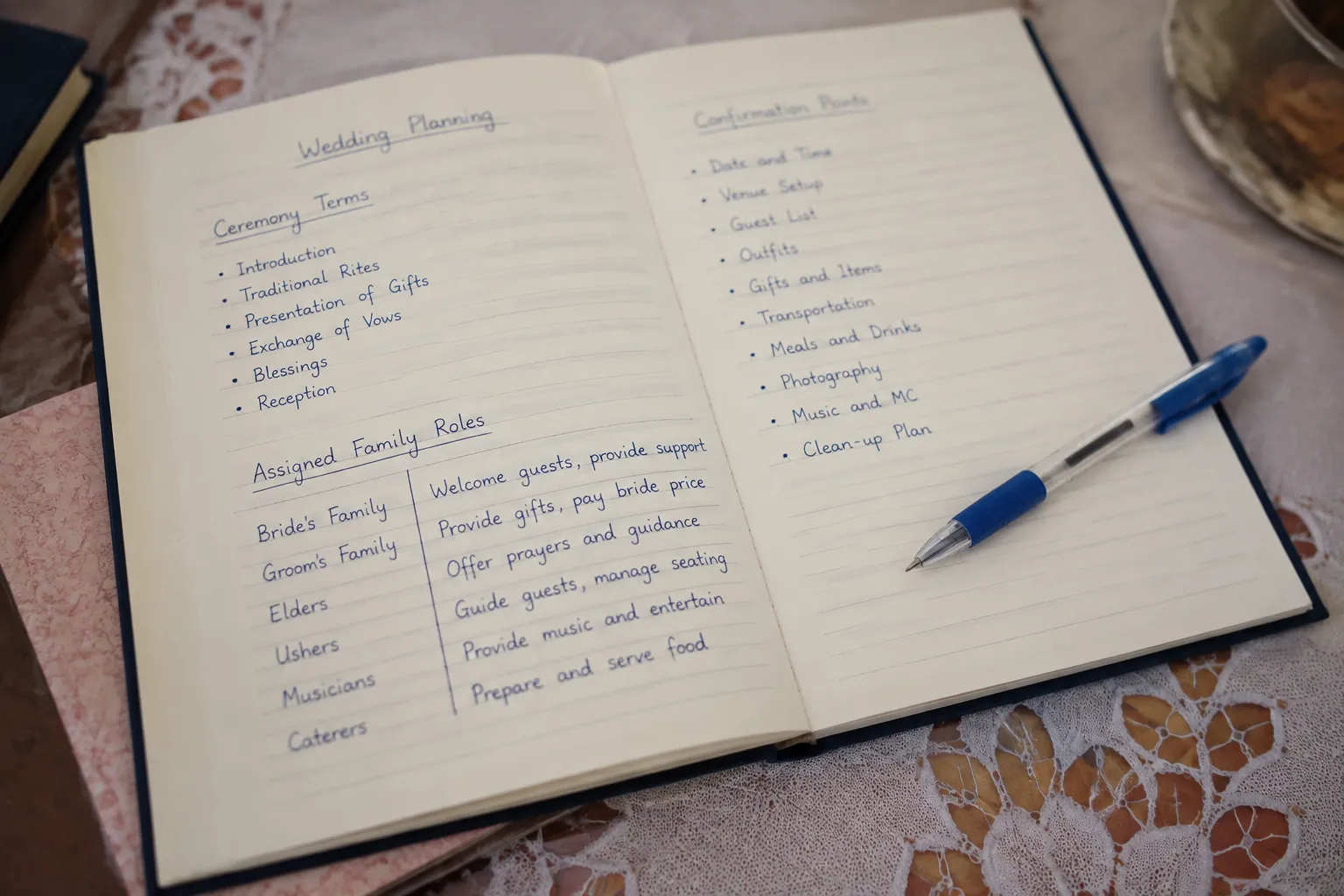
| Confirmation point | Questions for each family |
|---|---|
| Purpose | What does this meeting or ceremony accomplish for this family? |
| Responsible person | Which elder or family spokesperson gives the family response? |
| Attendance | Who is expected, and who is optional? |
| Presentation | What may be brought, shown, exchanged, or acknowledged? |
| Speaking roles | Who opens the meeting, presents the request, responds, and closes? |
| Couple’s role | Must both partners be present, and when do they participate? |
| Completion point | What action tells the family that this stage is finished? |
| Next ceremony | Does another customary, church, civil, or reception event follow? |
| Timing | Does the next stage depend on a response, item list, payment, or available date? |
| Record owner | Who writes down the agreed meaning and shares it with the couple? |
Confirm What Each Ceremony Includes
A ceremony description should identify actions, not only objects. A list of drinks, gifts, clothing, or other presentation items does not explain who receives them, when they appear, or what acceptance means to that family.
1. State the family decision
Record what the family is being asked to consider or acknowledge. It may involve receiving an introduction, responding to an intention, discussing requested items, or completing a customary stage.
The family spokesperson should supply the wording. If the two sides describe the purpose differently, keep both descriptions visible until their representatives resolve the difference.
2. Describe the ceremony actions
- The visiting family arrives and is received.
- A designated spokesperson explains the purpose of the visit.
- The receiving family responds.
- Agreed items are presented or discussed.
- The couple participates at the agreed point.
- The families state whether the stage is complete.
- The next date or responsible person is announced.
This is a coordination model, not a standard Ghanaian sequence. Each family can amend, remove, or reorder the steps according to its agreement.
3. Clarify what presentations mean
Research across Ghanaian settings describes variation in items, payments, and the meanings families attach to exchanges. Work on Dagaaba marriage payments, for example, records disagreement across generations about their significance. An item cannot be interpreted from its name or price alone.
Ask whether it belongs to the initial approach or a later ceremony, who receives it, whether it opens discussion or completes an agreed obligation, and who confirms that it was received as intended. Do not copy an engagement list from another wedding and treat it as evidence of this family’s expectations.
4. Record the completion statement
The spokesperson should confirm whether the stage is complete, partly complete, or awaiting another action. Without that statement, the couple may leave believing the engagement is finished while an elder expects a later presentation or meeting.
Decide Who Attends Each Ceremony
Attendance is an immediate consequence of unclear Ghanaian wedding terms. A “small knocking” may still require particular elders or spokespersons, while a “traditional engagement” may range from a family meeting to a larger guest event.
Separate decision-makers, ceremony participants, operational workers, and general guests:
- Family decision-makers: people whose presence or delegated authority is needed for the family conversation.
- Ceremony participants: people who present, respond, receive items, introduce the couple, pray, or perform another agreed role.
- Operational participants: planners, photographers, videographers, caterers, musicians, drivers, or venue representatives needed for that event.
- General guests: friends, colleagues, children, diaspora relatives, or church members invited at this stage or a later celebration.
Ask the family spokesperson for names or role categories, then set a date after essential participants have confirmed availability. The event name alone does not settle attendance.
Assign Responsibility at Each Handoff
Ceremony expectations become manageable when every decision has an owner. “The family will handle it” is too broad for scheduling, purchasing, or guest communication.
| Decision | Responsible person | Confirmation needed |
|---|---|---|
| Meaning of each family term | Each family spokesperson | Definitions accepted by both sides |
| Required attendees | Relevant elder or spokesperson | Names and delegated representatives |
| Presentation items | Person appointed by the receiving family | List, quantities, and interpretation |
| Purchasing or sourcing | Assigned relative or couple | Budget and completion date |
| Ceremony sequence | Family representatives with the planner | Agreed running order |
| Venue and arrival time | Couple or planner | Access time and family arrival plan |
| Photography coverage | Couple and photographer | Events, people, and presentation details |
| Guest communication | Assigned relative or couple | Correct event name, date, and audience |
| Next-event handoff | Named family representative | Date owner and confirmation deadline |
Record who can change each decision. A relative who purchases items may not have authority to revise the list, and a planner preparing the programme may not have authority to alter a family rite.
Schedule Ghanaian Wedding Ceremonies Around Dependencies
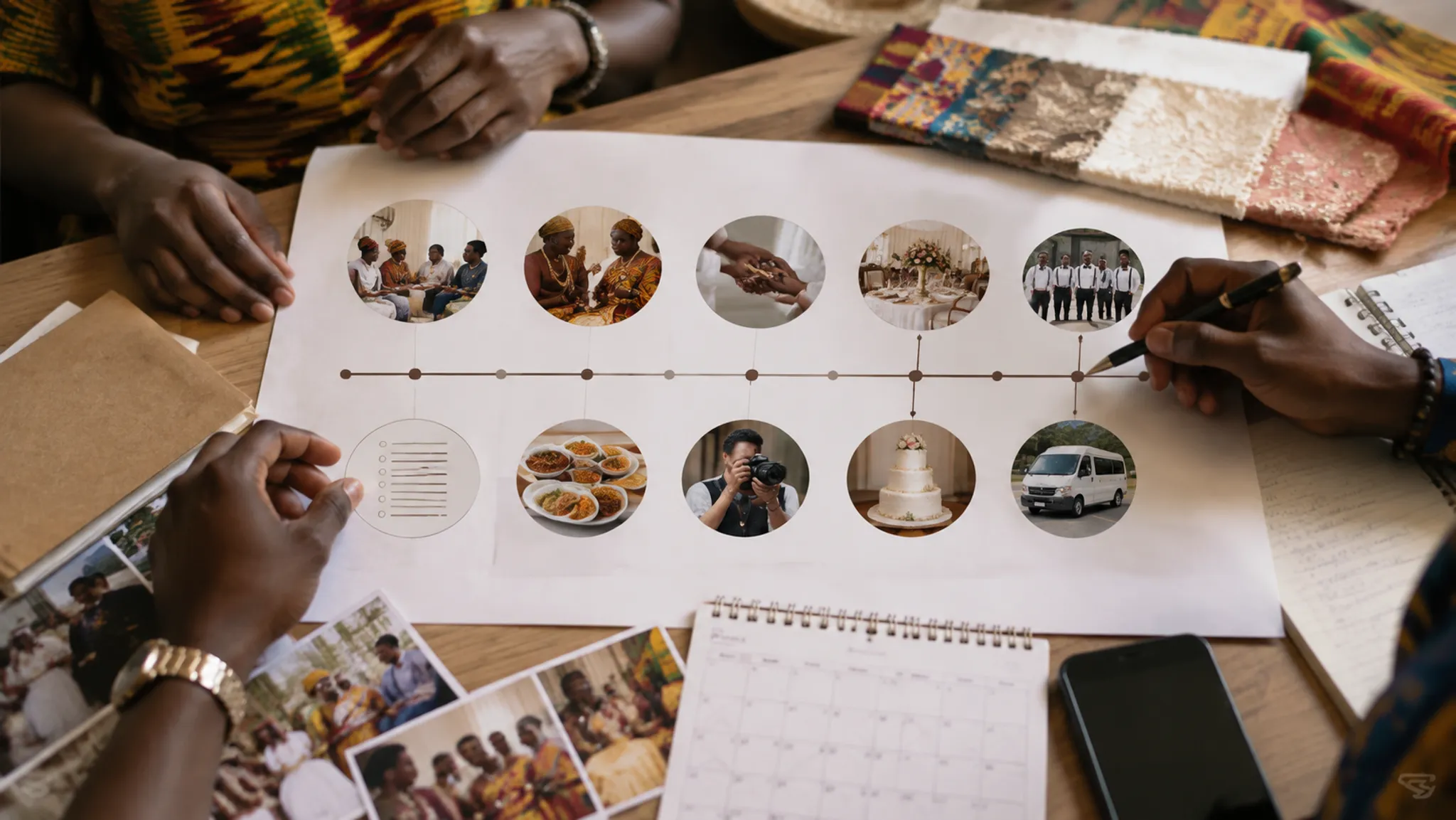
Dates should follow confirmed dependencies rather than assumptions about what usually comes next.
Before setting the knocking date
Confirm the purpose of the visit, the family spokespersons, the required attendees, and whether anything will be presented. Establish who will receive the response and how the next stage will be arranged.
Before announcing a traditional engagement
Confirm whether it is separate from the knocking ceremony or combines several stages. Determine the guest scale, presentation requirements, speaking roles, venue needs, and completion point.
Ask whether a church ceremony, civil appointment, or reception follows. Those dates can affect travel, attire, vendor bookings, and the availability of close relatives.
Before briefing vendors
Give vendors an action-based programme. “Cover the engagement” does not tell a photographer when family arrivals, presentations, the couple’s entrance, formal responses, or group portraits will occur.
The caterer needs the actual guest count and service period. The venue needs access and closing times. Drivers need the locations of consecutive events. Each vendor dependency should trace back to a family decision already confirmed.
Before diaspora guests book travel
Tell traveling guests which event they are being invited to and whether other ceremonies follow. Separate confirmed dates from provisional ones, and name who will announce changes.
Record Family Ceremony Terms in One Working Document
The couple needs one shared record that turns family language into planning instructions. The couple, a designated relative, or a planner can maintain it, but each spokesperson should review the section attributed to that family.
For every term, record:
- the term used by the family
- the family’s plain-language meaning
- the purpose of the event
- required and optional attendees
- expected presentation items or discussions
- speaking and receiving roles
- the agreed completion point
- whether another ceremony follows
- the person responsible for the next handoff
- the date by which unresolved details will be confirmed
Keep unresolved points visible. “To be confirmed by the family spokesperson on Friday” is more useful than filling a gap with an assumption.
A change from a private family meeting to a larger customary engagement can alter the budget, venue, clothing plan, photography coverage, transport, and guest travel. Preserve the updated definition and notify everyone affected.
A Worked Alignment Scenario
Suppose one side calls the proposed date the knocking, while the other calls it the traditional engagement. Pause vendor commitments and ask both spokespersons to describe the intended event.
The first family expects introductions, a statement of intention, and discussion of what comes next. Attendance is limited to selected relatives. The second family expects requested items, coordinated attire, and photographs with a wider family group.
The actions show that the families are planning different events. Their representatives can then choose among three planning options:
- Keep the first date as a limited knocking ceremony and schedule the customary engagement later.
- Combine the expected actions into one event after agreeing on the programme and completion point.
- Keep one date while narrowing or expanding attendance, presentations, and vendor coverage under a new joint definition.
After choosing, the couple records the decision, assigns the next tasks, and sends the revised event description to relatives and vendors. This illustrates a coordination method; it does not establish how other Ghanaian families divide the ceremonies.
Keep Ceremony Coordination Separate From Formal Status
Family terminology does not by itself establish whether a marriage has been registered or what formal process applies. The supplied cultural research does not provide current public-authority instructions on registration, documents, fees, deadlines, or marital status.
If formal status matters to the couple’s plans, treat it as a separate confirmation path. Check current, jurisdiction-specific information with the relevant Ghanaian registrar or a qualified legal professional before relying on a ceremony label or family sequence.
The planning record can show that this separate check is pending. It should not treat “knocking completed,” “engagement completed,” or “church ceremony booked” as an answer to a registration question.
Ghanaian Ceremony Planning Questions for the Next Family Meeting
- What does our family mean by “knocking”?
- What does our family mean by “traditional engagement”?
- Are these separate ceremonies, combined stages, or two names for one event?
- What does each ceremony include?
- Who attends each ceremony, and whose presence is essential?
- Who speaks for each family?
- What may be presented, and what does its acceptance mean in this family?
- Does the couple participate throughout or enter at a particular point?
- What action marks the ceremony as complete?
- If another ceremony follows, who initiates its planning?
- Which decisions belong to the family, the couple, the faith community, or another institution?
- Who records the answers and circulates them?
- Which details remain provisional, and when will they be confirmed?
End the meeting by naming the next responsible person and a confirmation date. “The families will discuss it” is not yet a handoff.
Evidence Limits Behind the Terminology
The available material includes scholarly work from several Ghanaian cultural and geographic settings. It supports the conclusion that ceremony stages and meanings can vary, while providing bounded Anlo, Krobo, Akan, Winneba, and Dagaaba examples.
The evidence does not support one nationwide definition of knocking versus traditional engagement, one required engagement list, or one ceremony sequence for all Ghanaian families. Use the research to ask better questions, then let the authorized family representatives determine what the terms mean for the ceremony being planned.
Frequently Asked Questions
Is knocking the same as a traditional engagement?
Some families may treat the terms as interchangeable, while others distinguish them. Confirm the purpose, participants, presentations, completion point, and next ceremony with each family spokesperson.
Which ceremony normally comes first?
The supplied research documents locality-specific sequences but does not establish one national order. Ask whether the initial approach, consent discussion, requested-item process, and customary celebration are separate or combined in this case.
Who should define the family meanings of knocking?
The person authorized to speak for that family should confirm the meaning, often an elder or appointed family spokesperson. The couple or planner can record the definition and identify who approves later changes.
What belongs in an engagement record?
Record the purpose, attendees, family roles, presentation items, actions, completion point, next event, responsible people, and confirmation dates. Mark unresolved decisions clearly.
Can a planner decide which tradition applies?
A planner can organize questions, document decisions, and coordinate the resulting schedule. Family representatives need to confirm family-specific meanings, expectations, and ceremony roles.
Should vendors be booked before the terminology is settled?
Major commitments are easier to assess after the event scale, sequence, locations, guest count, and required coverage are known. When an early booking is necessary, give the vendor confirmed facts and identify what remains provisional.
Does completing a family ceremony answer registration questions?
A ceremony label alone does not answer questions about registration or formal status. Those questions require a separate check against current, jurisdiction-specific information from the relevant registrar or a qualified legal professional.
The Confirmation That Moves Planning Forward
Terminology alignment is complete when both families can describe the same event in actions rather than labels. The couple should know who will attend, what may be presented, who will speak, what finishes the stage, and whether another ceremony follows.
Record that agreement, assign the next handoff, and schedule relatives, vendors, and traveling guests against the ceremony the families have actually defined.
Sources
- Essentials of an Akan Customary Marriage
- Examining the significance of visual artifacts in Anlo traditional marriage system in the Volta region of Ghana
- Between Tradition and Modernity: Dynamics of Krobo Marriage Rites in the Eastern Region of Ghana
- Decolonizing The Parallel Marriage Ceremonies in the Ghanaian Context
- Agents and challenges associated with the celebration of parallel marriage ceremonies in Winneba township in the Efutu municipality of Ghana
- Decolonising Mind and Being Associated with Marriage: Perspectives from Ghana
- ‘If it’s Your Money, I Will Pay and Go’: Shifting and Contested Significance of Brideprice Payment among the Dagaaba of Northwest Ghana